What Makes WordPress Great
Before anything else: WordPress is open source. Anyone can contribute, fork it, build on top of it. That openness is why the ecosystem is so rich. There are thousands of plugins, themes, and tools built by independent developers who genuinely care about their craft. You can find a solution for almost anything, and you can always choose how you want to work. That freedom is rare, and it’s worth protecting.
Gutenberg: Built for Whom, Exactly?
Here’s my honest take on Gutenberg: it feels like it was designed by people who had never tried to build a real website with it.
For writing blog posts? Fine. It works. But the moment you try to use it to build actual page layouts, you hit a wall. Spacing, alignment, custom components — everything that should be straightforward becomes a series of workarounds. The interface feels like it was designed for a word processor, not a visual web tool.
And the community agrees. The ratings speak for themselves. Gutenberg has been one of the most divisive things WordPress has shipped in its history, and years later the friction hasn’t gone away. Developers either reach for a page builder like Bricks or Elementor, grab a plugin like GenerateBlocks or Kadence to patch over Gutenberg’s shortcomings, or they build everything from scratch in code. That’s three workarounds for a tool that was supposed to simplify things.
The deeper problem
It’s not just that Gutenberg isn’t great. It’s that WordPress went all-in on it as the future of the platform, at the expense of other priorities. A lot of energy went into something the community didn’t fully ask for.
The Backend Needs a Redesign
If I were running WordPress, the first thing I’d prioritise is the admin experience. Not new features. Not another editor iteration. The dashboard itself.
WordPress’s backend hasn’t fundamentally changed in years. It’s functional, but it’s cluttered, dated, and increasingly intimidating for new users. The menu structure, the settings pages, the media library — it all feels like layers added on top of layers, never properly cleaned up.
Compare that to Craft CMS or Statamic. Both have clean, modern admin interfaces that feel designed with intention. New users can find their way around without a tutorial. Everything has a place. That first impression matters, and for WordPress it’s often not a good one.
For experienced developers, the backend is just something you navigate around. But for clients and new users, it’s the thing that makes them say “I don’t get this.” That’s a problem WordPress shouldn’t be ignoring.
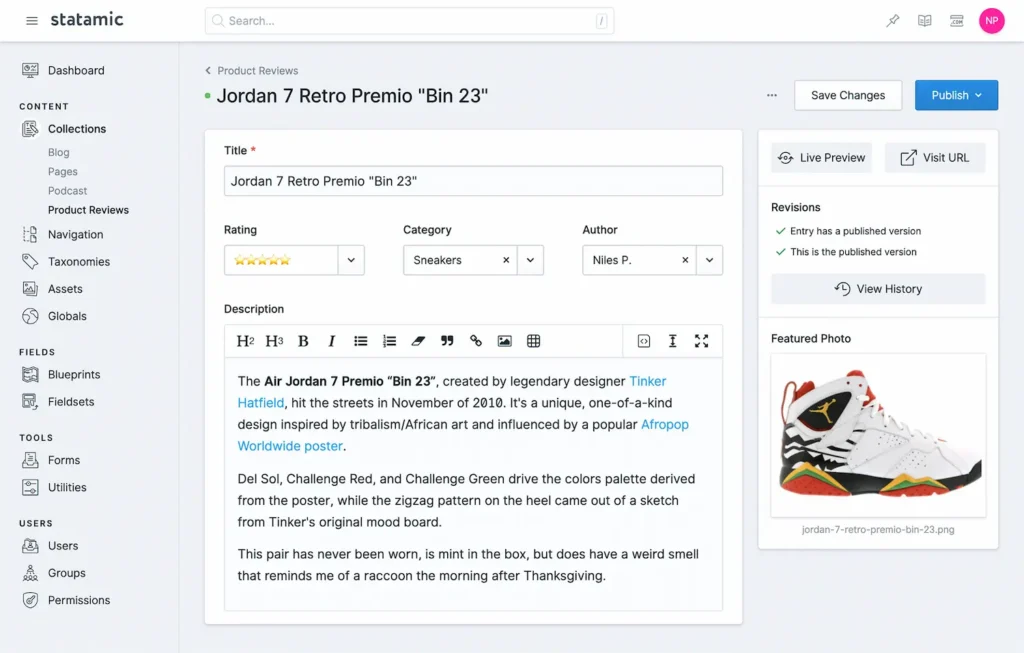
Example of Statamic
The ACF Situation
This one is harder to talk about without getting frustrated.
Advanced Custom Fields has been a cornerstone of WordPress development since 2011. Custom fields are not a niche feature. They’re fundamental to content management. The fact that WordPress never built a proper native solution for this, and instead the community relied on a third-party plugin for over a decade, says something on its own.
Then, in October 2024, WordPress.org forcibly took over the ACF plugin from WP Engine, the company that owned it, renaming it Secure Custom Fields. The official justification was a security vulnerability and removal of commercial upsells. But the timing wasn’t coincidental: it happened in the middle of a very public legal dispute between Matt Mullenweg and WP Engine. Many in the community described it not as a fork, but as a hijacking. Notably, the wider WordPress Security Team was not consulted before the announcement was made.
One prominent developer described Automattic’s actions as a threat to every paid plugin developer on the platform: if Automattic can effectively nullify a commercial plugin by forking it and making it free, no paid plugin business on WordPress is truly safe.
My take: even if there were legitimate security concerns, the way this was handled was wrong. The energy spent on that conflict could have gone somewhere far more useful, like building proper custom field functionality natively into WordPress. That’s where it belongs. A content management system that requires a third-party plugin for custom content fields is, by definition, missing something fundamental.
The Media Library Has No Folders
This might sound like a small thing, but it isn’t. WordPress has no native folder structure in the media library. You upload images, videos, and documents into one flat list that grows indefinitely. The only way to organise anything is to install a third-party plugin.
In 2025. A CMS. With no media folders.
Craft CMS has had asset management with folders, subfolders, and search built in from the start. Statamic too. It’s not a complex feature. It’s a basic one. And yet here we are, still waiting.
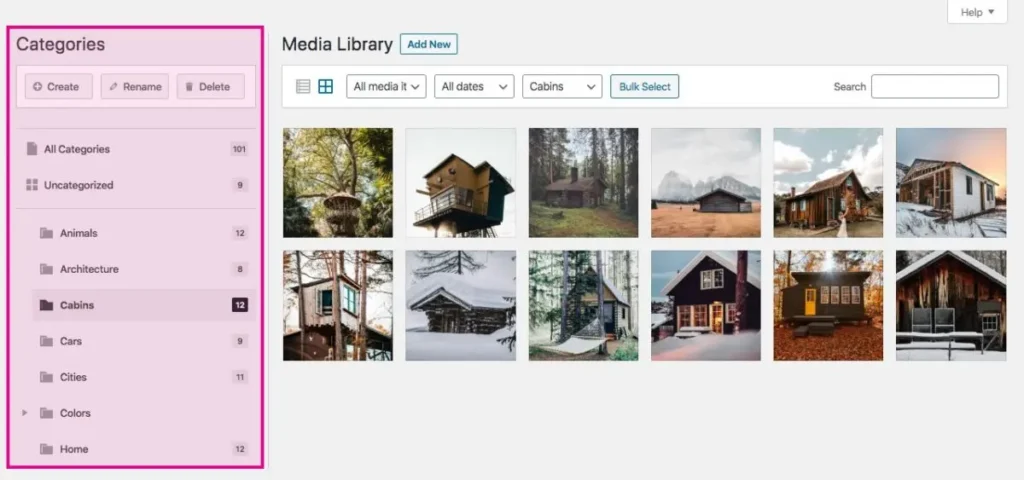
Example of Happyfiles Plugin
User Roles: Powerful but Inflexible
WordPress has five default user roles: Administrator, Editor, Author, Contributor, and Subscriber. For simple sites, that’s fine. But the moment you need something in between, you’re stuck.
A common scenario: you hand over a site to a client and give them Administrator access because Editor doesn’t let them do everything they need. Now they have full control, including the ability to install plugins, break the layout, or accidentally delete things. The right solution would be a custom role with exactly the permissions they need. But WordPress has no native way to create custom roles without either writing code or, again, installing a plugin.
This is a real limitation for agencies. Client handoffs would be so much cleaner with a proper, built-in role editor where you can tick exactly what each user can and can’t do.
Where Does This Leave Us?
I’m not switching away from WordPress. The ecosystem is too valuable, the community too large, and the flexibility too hard to replicate elsewhere. But I’d be doing the community a disservice by pretending everything is fine.
WordPress’s strength has always been its openness. The best things about it have been built by independent developers, not by the core team. The pattern is clear: the community builds what WordPress doesn’t.
That’s not sustainable forever. At some point, the platform itself has to lead. And right now, I’m not sure it is.